

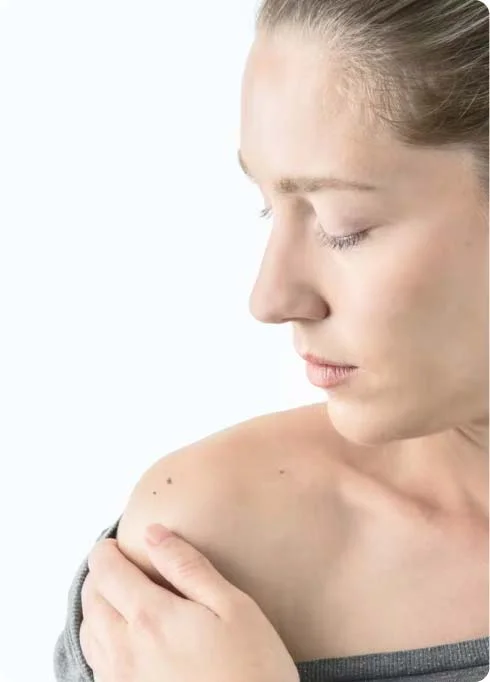
Moles
It is not uncommon for moles to exist. Most people have a few moles on their skin. It is essential to be aware that melanoma, a type of skin cancer, can originate from a mole. A skin check is recommended to check for signs of skin cancer.
What are Moles?
Your body has skin cells called melanocytes. These cells produce melanin, which determines the color of your skin. Melanocytes can grow in clumps, producing a mole. Nearly everyone can have between 10 and 40 moles, and they can be many different colors or textures, but they are usually less than 6 millimeters in diameter.
Moles can be an early sign of skin cancers like melanoma, and melanoma can be fatal. This is why you should do a self-exam periodically. According to the Mayo Clinic, signs to look for include:
- An asymmetrical shape
- An irregular border
- A change in color
- A diameter larger than 6 millimeters
- A change in shape, color, size, or height
When Should I see a Dermatologist for Moles?
You should see your dermatologist at FDL Dermatology if you have a mole that is:
- Showing any of the signs listed above
- Burning or itching
- Bleeding or oozing
- Painful
- Growing back after a previous removal
- New and you are over 30 years old
What are Some Ways to Treat Moles?
FDL Dermatology offers a full range of skin services, including mole removal. Your dermatologist may recommend:
A Surgical Shave Of Your Mole
Your dermatologist will numb the area and cut around the mole and underneath it. Shaving is often used for smaller moles; no suturing is required.
A Surgical Excision Of Your Mole
Your dermatologist will numb the area and cut out the mole with a punching instrument. Surgical excision requires sutures.